Pool blog
Pool clarifier: when to use it, how much to add and how it differs from algaecide
Short answer: a pool clarifier is a liquid that binds the finest particles into larger flocs, and the filter traps them. On the Acuático sheets, clarifier and flocculant are the same type of product. The dose is 50–70 ml per 10 m³ with Azuro Flokul and 20–40 ml per 10 m³ with Azuro Bright, once the pH is between 7.0 and 7.4.
Here you will see when to use a clarifier, how it differs from algaecide and chlorine, how to dose it and what to do if the water is cloudy after chlorinating. The data come from the sheets of the two Acuático products.
Pool clarifier: what it is and when to use it
Short answer: a clarifier is for cloudy water with a brownish tint. It does not disinfect and it is not for green water, so you add it when the pH and the disinfectant are already in order.
According to the Flokul sheet, you use the product once the pH and the disinfectant (free chlorine or oxygen) have settled. The colour of the water, in addition, points to the cause. For example, brownish cloudiness is particles, green water is algae, and milky white water is usually a wrong pH.
| Product | What it does | When |
|---|---|---|
| Clarifier (flocculant) | binds fine particles into flocs that the filter traps or that sink to the floor | cloudy water with a brownish tint, with the pH and the disinfectant in order |
| Chlorine | disinfects the water; according to the Azuro labels, free chlorine is between 0.3 and 0.5 mg/l | when free chlorine drops below 0.3 mg/l; see the article on pool chlorine |
| Algaecide | works against algae | green water; the clarifier sheet points to an algaecide or to adjusting the pH |
If the water is green, however, the clarifier is not suitable. Remove the algae, as the article on green water explains. If it is milky white, correct the pH with the pH regulators. To test chlorine and pH, use strips, drops or tablets.
Flocculant or clarifier: Azuro Flokul and Azuro Bright
Short answer: both are liquid flocculants of 1 l. Bright also works in the cold and with fewer filtering hours, and Flokul has a higher dose.
| Product | Dose per 10 m³ | Filtering | pH before use | Feature | Price from |
|---|---|---|---|---|---|
| Azuro Flokul | 50–70 ml | 24 hours | 7.0–7.4 | 50 % active substance; not for green water | 6.30 € |
| Azuro Bright | 20–40 ml | at least 6 hours | 7.0–7.4 | also works at low temperatures; with disinfectants with or without chlorine | 9.19 € |
Prices include VAT and date from 18/11/2026, and they may change. Both pool clarifiers are in the other chemicals category.
Note that in the article on pH, the general range for swimming is 7.2–7.6, and the clarifier sheets ask for a pH of 7.0 to 7.4. So test the pH before you use it.
Dosage by pool volume
Short answer: you dose Flokul at 50–70 ml per 10 m³ and Bright at 20–40 ml per 10 m³. So first work out the volume of the pool to dose the pool clarifier well.
| Water volume | Azuro Flokul | Azuro Bright |
|---|---|---|
| 5 m³ | 25–35 ml | 10–20 ml |
| 10 m³ | 50–70 ml | 20–40 ml |
| 20 m³ | 100–140 ml | 40–80 ml |
| 30 m³ | 150–210 ml | 60–120 ml |
| 50 m³ | 250–350 ml | 100–200 ml |
You work out the volume with the formulas for the volume of a pool. A 1 l bottle treats about 143–200 m³ with Flokul and 250–500 m³ with Bright. One treatment of 10 m³ costs 0.32 to 0.44 € with Flokul and 0.18 to 0.37 € with Bright (calculated from the prices of 18/11/2026).
Step-by-step method
Short answer: to use the pool clarifier, correct the pH, dissolve the dose in a bucket of water, pour it in and let the filter run. Then vacuum the flocs from the floor.
- Correct the pH to 7.0–7.4 and check the disinfectant.
- Dissolve the dose in a plastic bucket of water. With Flokul, 50–70 ml is 4 tablespoons.
- Pour Flokul slowly next to the skimmer opening, with the filtration running. Pour Bright evenly around the edge and near the skimmer.
- Keep the filter running: 24 hours with Flokul and at least 6 hours with Bright.
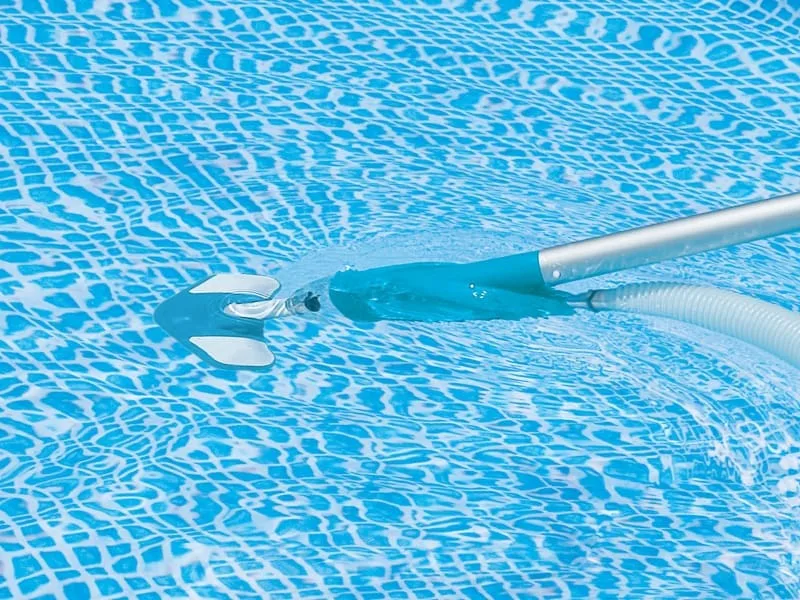
- Vacuum the flocs from the floor with a manual head such as the Vac Deluxe (9.82 €).
The sheets warn that the products can corrode metals. In addition, the Flokul sheet says it causes serious eye damage, and the Bright sheet says serious eye irritation. So read the label carefully before you use them.
Cloudy water after chlorinating: what to do
Short answer: cloudiness right after shock chlorination is normal: it is dead algae and sediment. Let the filter run and then vacuum the sediment.
If the water stays cloudy, first correct the pH, check the chlorine and run the filtration for 24 hours. Only if it stays cloudy, add the pool clarifier then. You will find more steps in the article on cloudy pool water. The products are in the pool chemicals category.
Frequently asked questions about the clarifier
Is a flocculant the same as a clarifier?
Yes: on the sheets, Flokul and Bright are called both clarifiers and flocculants (coagulants).
How do I use a pool clarifier?
To use the pool clarifier, dissolve the dose in a bucket of water and pour it next to the skimmer, with the filter running. Then vacuum the flocs.
What is the right dose?
Of pool clarifier, 50–70 ml of Flokul or 20–40 ml of Bright per 10 m³ of water, with the pH between 7.0 and 7.4.
Can I use it on green water?
No. With green or milky white water, first correct the pH or use an algaecide.
You will find clarifiers and pool chemicals in our pool shop Acuático.