Pool blog
Salt chlorinator maintenance: cell, salt, pH and winter care
Short answer: salt chlorinator maintenance comes down to watching the salt, the pH and the chlorine, looking after the cell and getting the unit ready for the cold. On the Salinator SSC-mini the salt level is 3 to 4 g/l, and on the Atlasprosalt it is about 4 g/l. Many of our units clean the cell by themselves, by reversing the polarity. Even so, follow the manual for your model.
Salt chlorinator maintenance: what to check and how often
Short answer: measure the salt at least 2 times a week, and more often when the water is warm. Also measure the pH and the chlorine. The table gathers the values from the regulation and from the manufacturers.
| Parameter | Value | Source |
|---|---|---|
| Salt by analyser | 2000–6000 mg/l; below 2000 mg/l the chlorinator works less well | salinity tester |
| Salt by unit | SSC-mini 3–4 g/l; Atlasprosalt 4 g/l; Intex Krystal Clear 3 g/l; REGUL about 4–5 g/l | product sheets |
| pH | 7.2–8.0; recommended 7.2–7.6 | Real Decreto 742/2013; SSC-mini |
| Free chlorine | 0.5–2.0 mg/l | Real Decreto 742/2013 |
| Combined chlorine | up to 0.6 mg/l | Real Decreto 742/2013 |
The regulation applies to public pools, and this salt chlorinator maintenance guide uses it as a reference. Also, when the pH is outside the right limits, chlorine works less well. So pH control and dosing is worth having, and so is our article on pool pH.
How to clean the salt chlorinator cell
Short answer: the cell cleans itself: the units reverse the polarity and so limit limescale build-up on the electrodes.
The Salinator SSC-mini has reverse polarity and a transparent cell holder, which lets you see the state of the cell. The REGUL cell cleans itself by polarity reversal and remembers the reversal cycle for a longer service life. The REGUL IDOit+ Connect has the same function. The Intex Krystal Clear has a programmable self-cleaning cycle.
The product sheets do not explain how to clean the cell by hand. So if you need to open or remove it, follow the unit's manual. In addition, a qualified specialist should do the installation and the electrical connection.
How often to replace the cell
Short answer: the product sheets do not give a number of hours for the life of the cell. They do give other facts that help you look after it.
The SSC-mini has a light that shows the cell's service life. According to the manufacturer, keep the salt above 3000 ppm so the electrodes last longer. The Atlasprosalt has titanium electrodes with a special long-life coating and 2 years of warranty on the control unit and the cell. The Intex Krystal Clear also has a 2-year warranty. Finally, the TDS sensor of the REGUL IDOit+ shows the exact amount of salt to add, and so it helps the cell last longer.
Why the salt chlorinator is not producing chlorine
Short answer: the causes the product sheets point to are cold water, too little salt, no circulation, a closed cover and unsuitable salt.
- Cold water: the SSC-mini does not produce chlorine below 10 °C, and it works with water from 10 to 45 °C.
- Too little salt: below 2000 mg/l the chlorinator works less well, and the SSC-mini asks for more than 3000 ppm.
- No circulation: the SSC-mini has a flow sensor, and its indicators show the cause, for example no flow. REGUL shows the circulation through the cell.
- Closed cover: on the Xsel, production drops when the roll-up cover is closed.
- Short running time: the SSC-mini has 10 levels, and each one equals 6 minutes of the hour. The Atlasprosalt has a programmable timer for filtration and chlorine separately.
- Limescale on the electrodes: reverse polarity limits it.
- Unsuitable salt: the SSC-mini asks for pure NaCl at 99%, with no rock salt, no iodised salt and no more than 1% anti-caking agents.
Salt for the chlorinator: how much and when to top up
Short answer: the salt is not used up, and you only top it up after backwashing, after draining water, after splashing and after rain. Read more in the article on how much salt a pool needs.
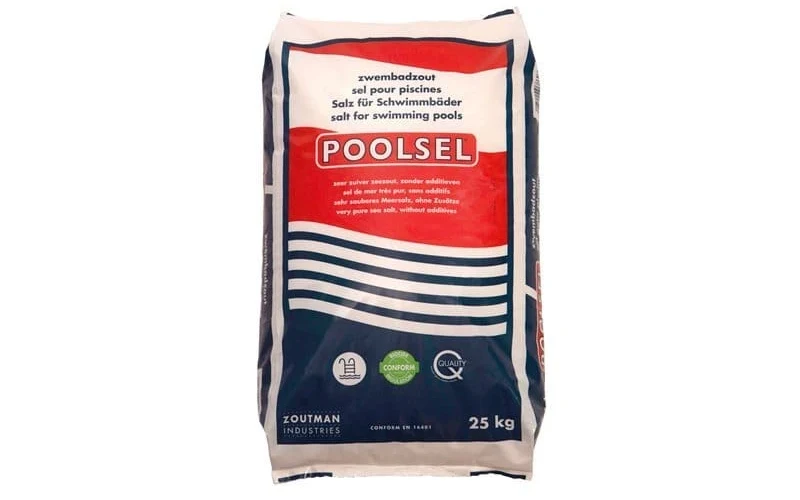
The technical pool salt is 99.6% NaCl. The optimum concentration is 2.5 to 4.5 kg per 1 m³ of water and, for the first fill, about 25 kg per 5–8 m³. The 25 kg bag costs 16.80 € on 18/11/2026, and the price may change. First dissolve the salt in a separate container of water, then pour it in with the filtration running. Do not rush: excess salt can only be removed by changing part of the water. Store the salt in a dry place, in the closed pack.
If you are unsure whether to switch to salt, see the comparison of salt and chlorine. The units are in the salt electrolysis category, and the salt is in pool salt.
Salt chlorinator in winter
Salt chlorinator maintenance in winter depends on the unit. The SSC-mini does not produce chlorine below 10 °C. The REGUL Xsel and IDOit+ have an automatic winter mode for cold water and for seasonal use. In addition, the Xsel DJ indicator shows low water temperature during winterisation. To remove and store the cell, check your unit's manual.
Frequently asked questions about salt chlorinator maintenance
How do you clean a salt chlorinator cell?
It cleans itself, by polarity reversal. The product sheets do not describe cleaning by hand, so follow the unit's manual.
How often do you replace the cell?
The product sheets give no hours. The SSC-mini has a light for the cell's service life, and the Atlasprosalt and the Intex give 2 years of warranty.
Why is the chlorinator not producing chlorine?
Check the water (below 10 °C the SSC-mini stops), the salt (below 2000 mg/l), the circulation, the cover and the running time.
How often do you measure the salt?
At least 2 times a week and, when the water is warmer, more often.
What pH does a salt chlorinator need?
Real Decreto 742/2013 allows 7.2–8.0, and the SSC-mini recommends 7.2–7.6. The REGUL IDOit+ adjusts the pH by itself.
You will find all the units and products in our Acuático pool shop.